Case Study
Better Housing Atlas
Building a living archive of housing projects
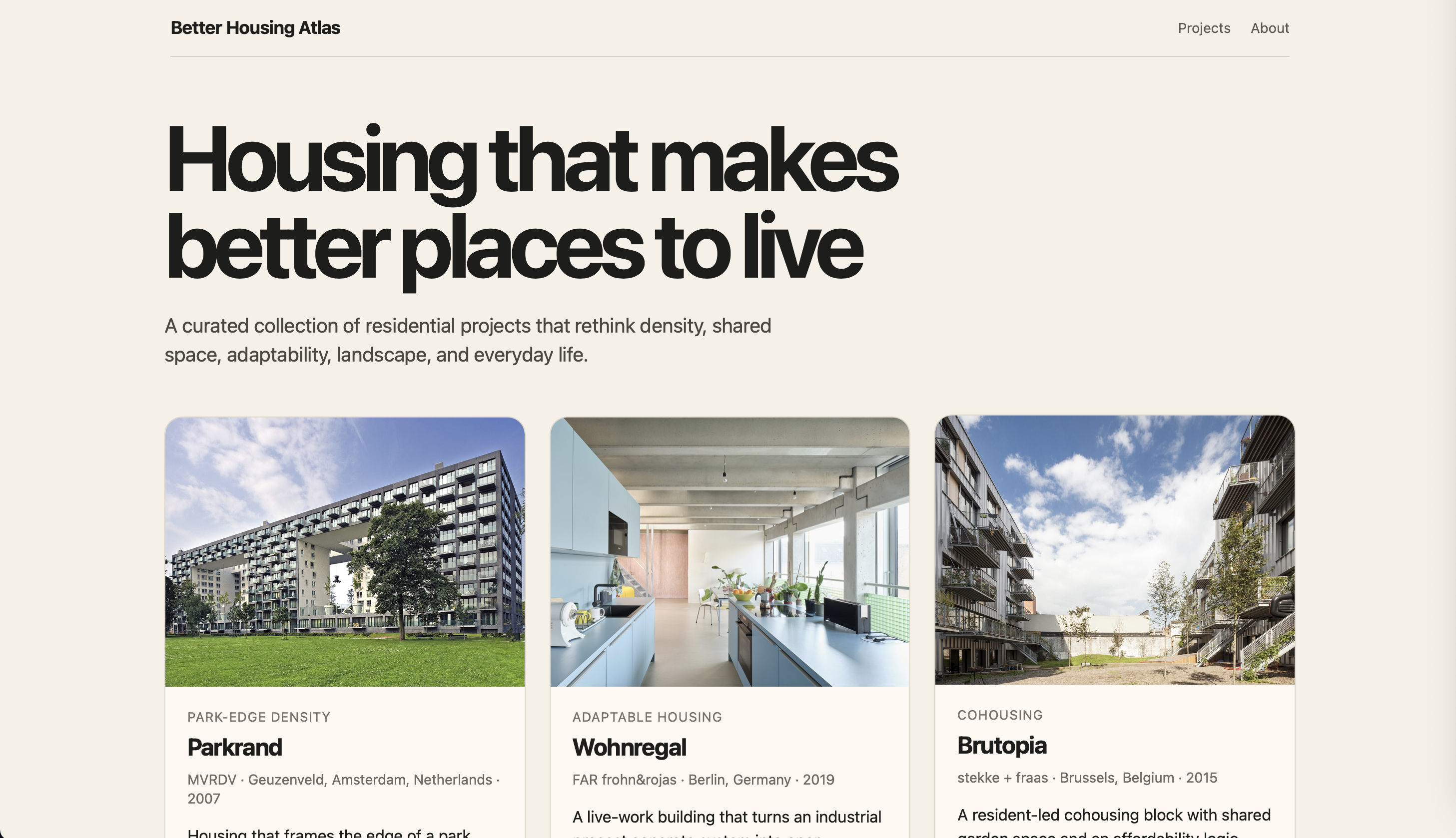
Better Housing Atlas is an independent reference library of housing projects designed with care, ambition, and attention to everyday life.
What started as a personal archive became an editorial system with a repeatable workflow for discovering, documenting, and publishing housing projects.
I created it to preserve examples of good housing: not luxury real estate or architectural spectacle, but thoughtful homes for ordinary people. Some are designed by internationally recognised practices, others by smaller studios. What matters is not the reputation of the architect, but the quality of the housing itself.
The project began as a personal collection and gradually became a public archive: a place to document projects in a consistent format, with clear credits, sources, and context.
| Role | Founder, Researcher, Product Builder |
| Timeline | May 2026 – Present |
| Status | Live MVP |
| Stack | SvelteKit, JSON, Vercel |
| Focus | Housing Research & Editorial Systems |
Why I built it
Preserving references as a durable, searchable archive
Over the years, I accumulated a growing collection of housing references: articles, PDFs, project pages, and photographs that I wanted to revisit later.
The collection kept growing, but it became increasingly difficult to navigate. Projects were scattered across different sources, described in different formats, and often lacked the context that made them interesting in the first place.
I wanted a more durable way to preserve and compare projects that felt important – not as bookmarks, but as a structured archive that could grow over time.
From collection to system
A consistent structure, applied carefully
The challenge was not finding projects. It was creating a structure that could be applied consistently across every entry while preserving what made each project unique.
Each project page combines factual information, editorial context, sources, and credits. The goal is to make projects easier to revisit, compare, and learn from over time.
Building the workflow
Repeatable editorial process for publication
Publishing a project required more than writing content.
I wanted every entry to have proper attribution and permission for image use, which meant creating a repeatable editorial workflow rather than simply collecting references.
By launch, I had contacted 35 architecture studios across Europe. Several studios provided image permissions, credit corrections, additional materials, and recommendations for future research.
Defining the MVP
Small scope, repeatable editorial value
For the first version, I deliberately kept the scope small.
The initial release included project pages, source attribution, credits, responsive layouts, and a workflow for adding new projects.
Features such as search, filters, maps, submissions, and CMS tooling were intentionally postponed. The priority was validating the editorial model before expanding the platform.
Shipped
- Homepage
- Project index
- Project pages
- Structured project data
- Credits and source attribution
- Responsive layout
- Publication workflow
Postponed
- Search
- Filters
- Maps
- CMS
- Public submissions
What shipped
A focused public release
The first public version launched with five published projects and a responsive mobile experience.
More importantly, it established a structure and workflow that made future growth possible. Additional projects were already in progress when the site launched, and new material continued to arrive after publication.
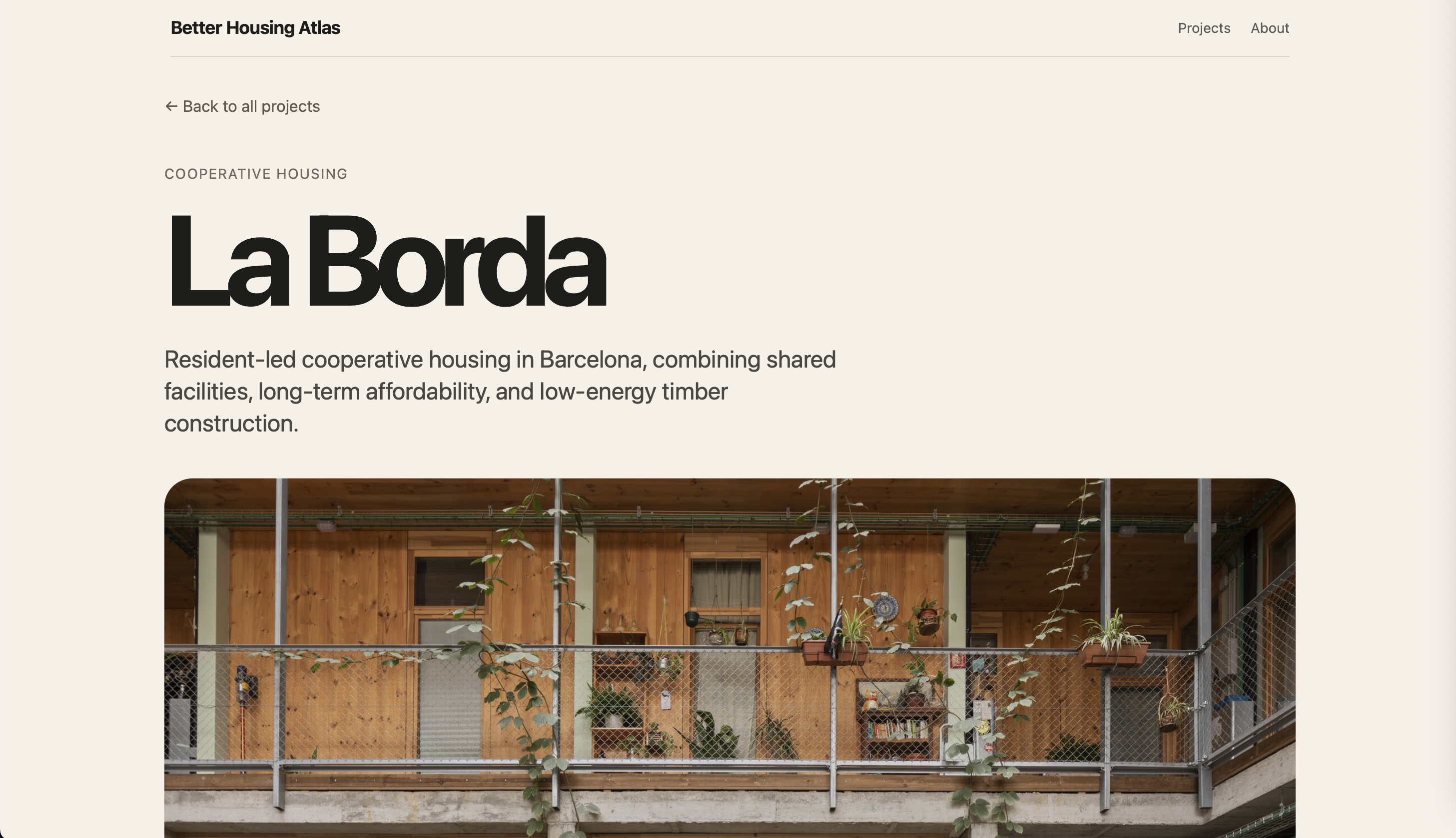
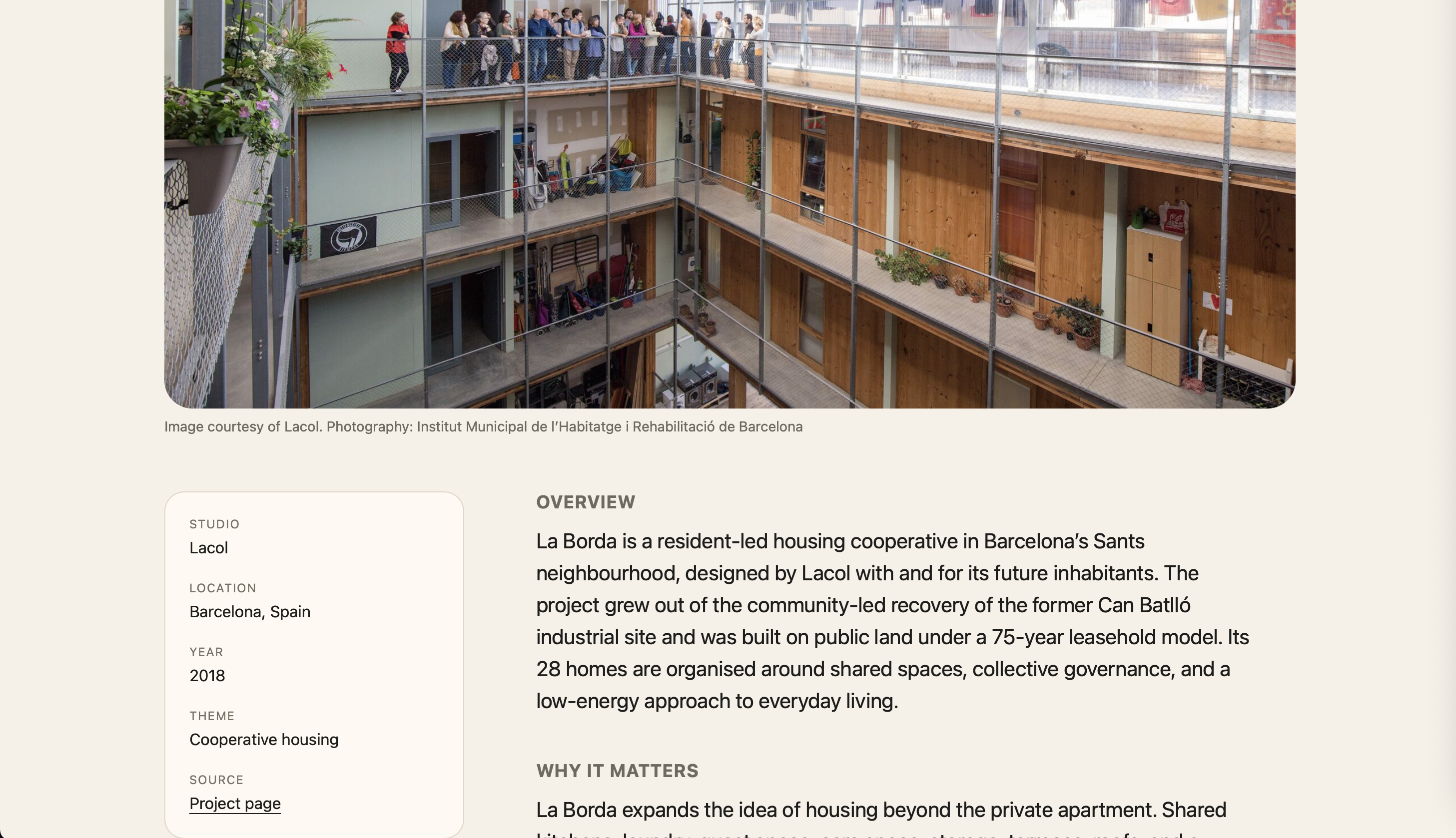
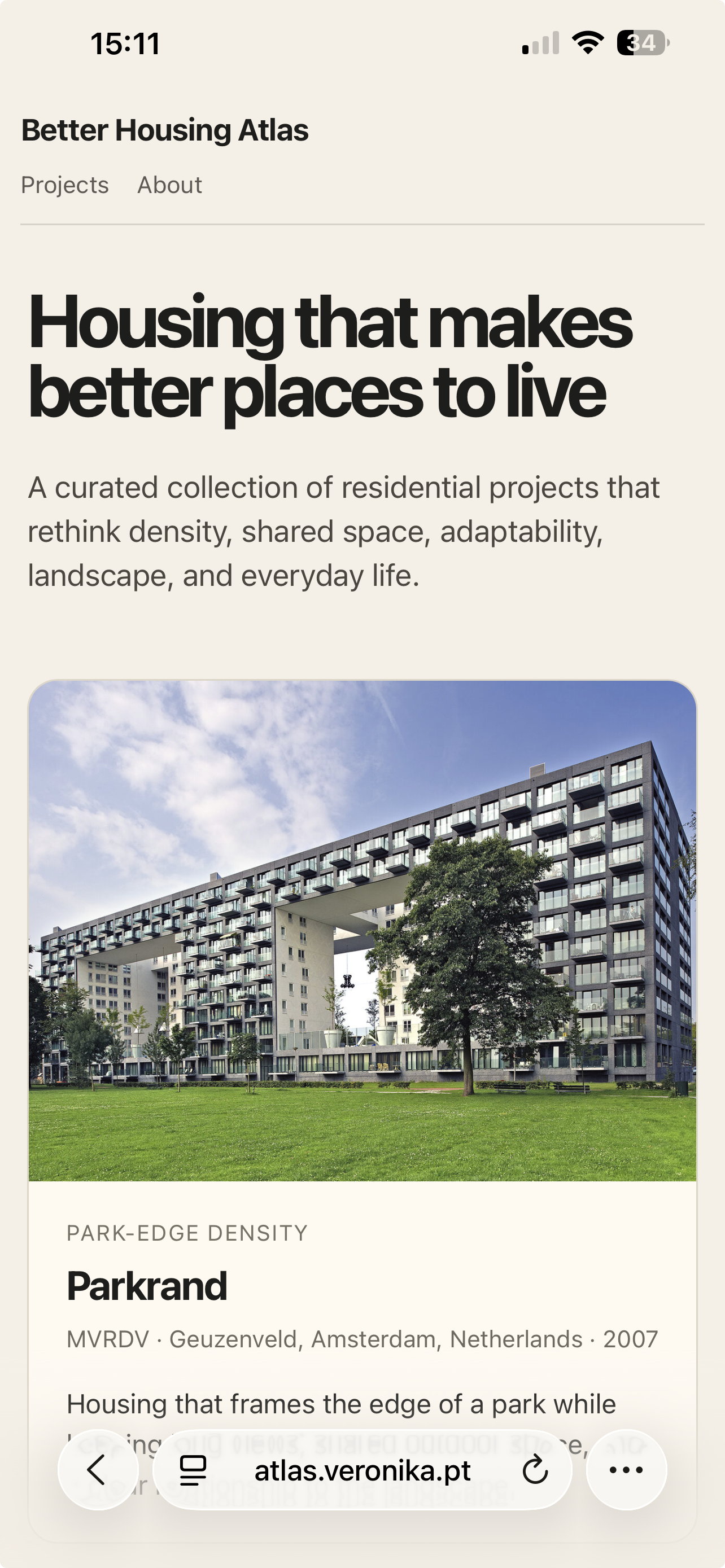
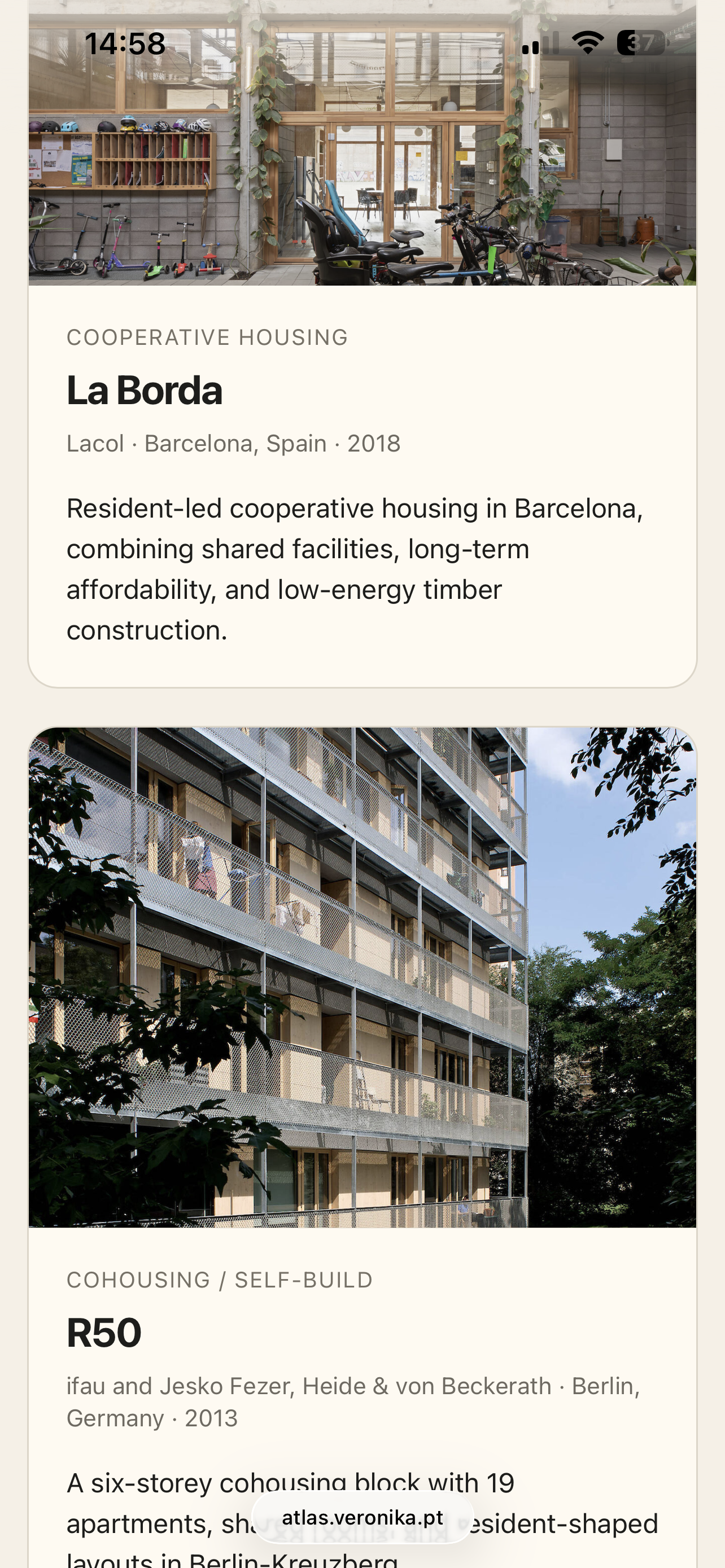
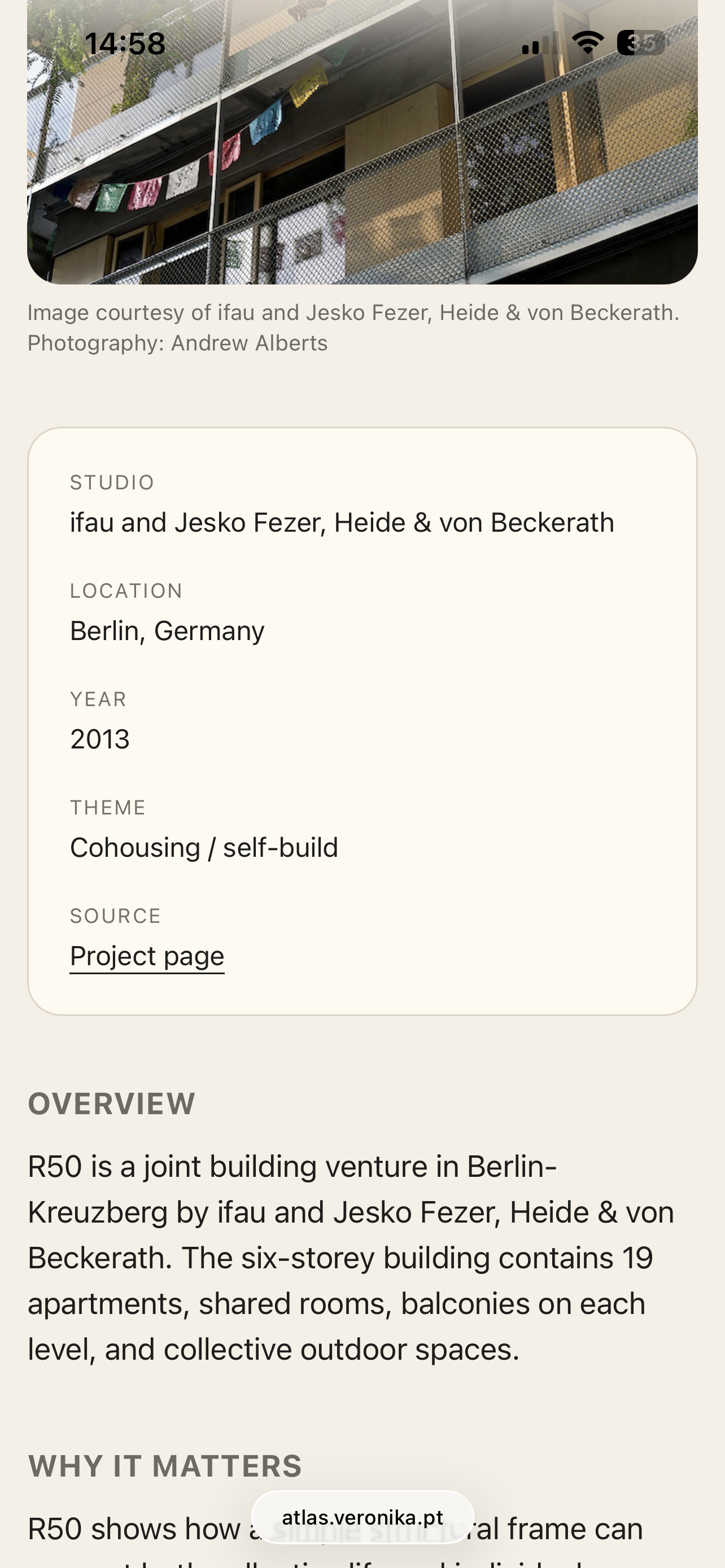
For the MVP, I used structured JSON instead of adding CMS complexity too early. The core object of the Atlas is the project page: photographs, facts, context, why it matters, sources, and credits. The same structure had to work across the index, individual project pages, and mobile views, so the archive could stay simple, readable, and easy to extend.
Mobile views — The same project structure remains readable on smaller screens, from the index to individual entries.
Outcome
What this proved
The launch tested more than the website. It tested whether the Atlas could work as a repeatable editorial system: finding projects, structuring information, requesting permissions, correcting credits, and publishing entries without redesigning the process each time.
By launch, I had contacted 35 architecture studios across Europe and published five projects with documented sources and credits. After the soft launch, additional studios responded with permissions, corrections, materials, and recommendations for future research.
The technical build was the easier part. The real work was turning scattered references into a system that could keep growing: structured data, clear editorial rules, a permissions workflow, and a public interface that made the archive readable.